English
 Chinese
 Vietnam
 Español
 Pусский
 Français
 العربية

The surface of a CI press drum is not a theoretical perfect circle. After thousands of hours of printing, even a high‑quality drum develops microscopic out‑of‑roundness from bearing wear and thermal expansion. A drum that is out of round by 0.05mm will cause the web to accelerate and decelerate twice per revolution as it passes over the high and low spots. On a six‑color napkin job at 160 m/min, that tiny speed variation shifts each color plate relative to the web by a few hundredths of a millimetre — enough to turn a fine brand logo into a blurred edge.
The YTC‑6600 printing machinery from Changs International uses a central drum that is dynamically balanced and ground to a roundness tolerance of 0.02mm. The drum is mounted on precision tapered roller bearings with preload adjustment, and the entire assembly is thermally stabilized to maintain geometry across temperature changes. This guide explains how drum roundness, bearing preload, and web tension interact to hold ±0.15 mm registration on 20 gsm tissue, why the 300‑800 mm repeat length range matters for different napkin folds, and how the ceramic anilox roller keeps ink volume consistent across six color stations.
The 0.02mm roundness tolerance: why the drum’s perfect circle matters more than its size
A CI press drum is typically 1000‑1500 mm in diameter. A 0.02mm out‑of‑round condition represents a variation of just 0.0015% of the circumference. Yet at 160 m/min, the drum rotates approximately 2‑3 times per second. Each time the high spot passes under a printing plate, the web experiences a microscopic speed pulse. Over thousands of impressions, the cumulative effect is a cyclical misregistration pattern that repeats every drum revolution — visible as a faint band across the napkin.
The YTC‑6600 drum is manufactured from high‑strength cast iron, then rough machined, stress‑relieved, and finish ground on a cylindrical grinder capable of holding 0.01mm roundness. After grinding, the drum is dynamically balanced to ISO G2.5 grade at operating speed. The final assembly includes a bearing preload adjustment that eliminates radial play without adding friction.
How bearing preload prevents the drum from wandering axially
The drum’s tapered roller bearings are preloaded by a calibrated nut. Too little preload allows the drum to shift axially under the load of the printing plates, causing side‑to‑side register drift. Too much preload overheats the bearings and shortens their life. The YTC‑6600 specification includes a preload torque value of 120‑150 N·m, measured at the bearing adjustment nut, verified during factory assembly. Maintenance records show that a properly preloded drum maintains its axial position within 0.02mm over 8,000 operating hours.
The servo‑driven infeed and outfeed: how closed‑loop tension eliminates the “roll core drift”
A napkin tissue roll starts at 1000 mm diameter and ends at a 76 mm core. At full roll, the web tension required to pull the material is low; at the core, the same torque would snap the tissue. Open‑loop tension control systems apply constant torque, resulting in high tension at the start and low tension at the end — or worse, constant tension but increasing torque demand as the roll shrinks, causing erratic web feed.
The YTC‑6600 uses closed‑loop tension control with a load cell dancer roller. The load cell measures actual web tension in real time and sends the signal to the servo drive. The drive reduces torque as the unwind roll diameter decreases, maintaining constant tension from full roll to core. The same principle applies to the rewind section, where torque increases as the finished roll builds to maintain constant tension.
| Tension Control Parameter | Value |
|---|---|
| Tension range | 5‑50 N/m (adjustable) |
| Control accuracy | ±1 N/m |
| Dancer roller type | Load cell with pneumatic assist |
| Unwind diameter range | 300‑1000 mm |
| Rewind diameter max | 800 mm |
The 300‑800 mm repeat length: what it means for quarter‑fold versus dinner napkins
The repeat length determines how many napkin sheets are printed per rotation of the printing cylinders. A short repeat (300‑400 mm) is used for quarter‑fold napkins where the design repeats 2‑4 times across the web. A long repeat (600‑800 mm) is used for large dinner napkins or for designs that span the full sheet.
The YTC‑6600 changes repeat length by adjusting the gearless servo drive to each printing station. On a mechanical press, changing repeat length requires swapping gear sets — a 45‑minute job. On the YTC‑6600, the operator enters the new repeat length into the HMI, and all six stations reposition simultaneously in under 5 minutes.
The repeat length also affects the maximum speed. At 300 mm repeat, the press runs 160 m/min, delivering roughly 32,000 impressions per hour. At 800 mm repeat, the speed may be reduced to 120 m/min to ensure consistent ink transfer across the longer plate.
Six colors, one drum: why the “first color” position is the most critical
On a CI press, the first printing station is located opposite the infeed section. The web contacts the drum at this point before it has been heated by the drum’s surface or stabilized by subsequent stations. The first color must therefore be printed at a slightly different drum temperature than the later colors, or the thermal expansion of the drum will shift the plate position.
The YTC‑6600 includes individual temperature control for each printing station, with heaters in the ink chamber and cooling air directed at the plate cylinder. The operator sets a temperature profile for the job — for example, station 1 at 38°C, stations 2‑5 at 40°C, and station 6 at 42°C — to compensate for the drum’s temperature gradient.
What happens when the temperature profile is wrong
A converter printing a six‑color design on 25 gsm tissue noted that the first color was fine, but the fifth and sixth colors were consistently misregistered by 0.3mm. The cause was that the drum’s temperature had increased from 35°C at the infeed to 42°C at stations 5 and 6, expanding the chrome surface by approximately 0.02mm per metre of circumference — enough to shift the later plates out of register. After adding a cooling air blower at station 5 and reducing the drum’s setpoint from 42°C to 38°C, registration returned to ±0.15mm.
[Image: YTC‑6600 central drum with six printing stations, showing the temperature control system at each station and the load cell dancer roller at the infeed]
Ceramic anilox rollers: why 60 L/cm may be too high for tissue but perfect for paper
The anilox roller transfers ink from the chambered doctor blade to the printing plate. The cell volume (measured in cm³/m²) determines how much ink is laid down. A high cell volume (e.g., 8‑10 cm³/m²) is used for opaque coverage on non‑absorbent substrates. A low cell volume (e.g., 3‑5 cm³/m²) is used for fine screens on tissue to prevent strike‑through.
The YTC‑6600 is supplied with a set of ceramic anilox rollers in different line counts, typically 60‑120 L/cm (lines per centimetre). For napkin tissue, 80‑100 L/cm with cell volume 3‑5 cm³/m² is standard. For paper bags, 60‑70 L/cm with cell volume 7‑9 cm³/m² provides solid coverage without excess ink.
The anilox roller is laser‑engraved with a ceramic coating that resists wear from the doctor blade. A worn anilox will produce lighter print in the centre of the web than at the edges because the blade wears the ceramic unevenly. The machine’s service schedule recommends measuring the anilox cell volume with a microscope every 1,000 operating hours and replacing the roller when volume drops by more than 15%.
Three field adjustments that separate a running CI press from a problem press
Adjustment one: The infeed nip roller pressure
The infeed section uses a rubber‑covered nip roller to pull the web off the unwind and feed it onto the drum. If the nip pressure is too low, the web slips and registration wanders. If it is too high, the roller crushes the tissue edges, causing edge tears. The correct pressure is 0.2‑0.3 MPa for 20‑30 gsm tissue, measured with a pressure gauge on the pneumatic cylinder. A practical field test: run a strip of paper through the nip and check for impressions; faint marks indicate correct pressure, deep embossing indicates overpressure.
Adjustment two: The plate cylinder impression setting
The printing plate must contact the web with enough force to transfer ink but not so much that the plate compresses and spreads the dot. The YTC‑6600 uses a digital impression gauge that reads the plate‑to‑drum gap in 0.01mm increments. For tissue, the recommended gap is 0.15‑0.20mm less than the combined thickness of the plate and adhesive tape. A gap too small will cause plate smashing; too large will cause incomplete ink transfer.
Adjustment three: The drying system air flow
The YTC‑6600 is equipped with hot air dryers between color stations. For water‑based inks on absorbent tissue, too much air flow will flutter the web before it reaches the next station, causing misregister. The recommended air speed is 10‑15 m/s at 50‑60°C for tissue, and 20‑25 m/s at 70‑80°C for non‑absorbent film. The air nozzles are adjustable; a visual check of web stability between stations should show no visible flutter.
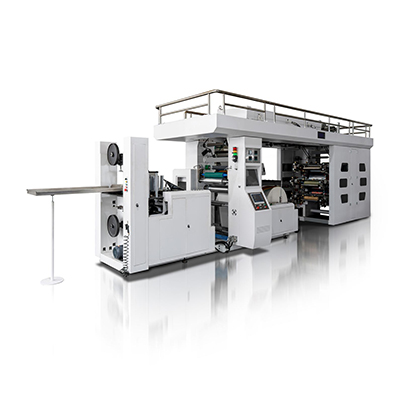
How the YTC‑6600 fits into Changs International’s printing machinery portfolio
Changs International has manufactured flexographic printing equipment since 2004, with products exported to over 40 countries. The YTC‑6600 is part of the YTC series of central impression flexo presses, which includes models with material feeding widths from 600 mm to 1400 mm. The series is designed for napkin, tissue, paper bag, and flexible packaging converters who require high‑speed, multi‑color printing on thin, extensible substrates.
The YTC‑6600 is CE certified and built with Siemens main drive, Delta inverters, and SMC pneumatic components. The press includes an automatic viscosity controller for each color station, a web cleaning system, and a corona treater for film applications. The machine is supplied with 100 mm thick side frames, precision helical gears, and a 2‑year warranty on the central drum bearings.
For printing machinery that holds 20gsm tissue in perfect register at 160 m/min across six colors, the YTC‑6600 central impression flexo press delivers the drum roundness, bearing preload, and closed‑loop tension control that in‑line presses cannot match.
【Request a quote from Changs International】
Contact Changs International with your substrate type (tissue, paper, film), required print width, and target speed for a YTC‑6600 or other YTC series CI flexo press recommendation.